For the bigger picture and full context, make sure you read our main guide on Sample Learning Goals: How to Help Students Succeed?.
markdown
Are your students truly reaching their learning potential, or are they just going through the motions? Concrete examples of student objectives can be the key to unlocking deeper engagement and demonstrable progress in any subject, but especially in mastering a language like English.
At a glance:
- Discover how specific, measurable student objectives transform learning outcomes.
- Learn to craft effective objectives using the SMART framework and Bloom's Taxonomy.
- Explore diverse examples across various subject areas and proficiency levels, including language learning.
- Uncover common pitfalls in setting objectives and how to avoid them.
- Get a practical playbook to implement student objectives immediately.
Why Examples of Student Objectives Matter: Beyond the Curriculum
Student objectives aren't just about ticking boxes on a syllabus. They are powerful tools that focus both the teacher's instruction and the student's learning efforts. Without clear objectives, students may flounder, unsure of what they're striving to achieve. Effective objectives provide a roadmap, allowing students to track their progress and experience a sense of accomplishment. This, in turn, fuels motivation and deeper learning. Examples of outputs: * student success with learning goals * Help students achieve more * Setting effective learning goals can be dramatically improved when students and educators partner with a clear vision of success.
The SMART Framework: A Foundation for Effective Objectives
The SMART framework provides a simple yet powerful structure for crafting effective student objectives. Let's break it down:
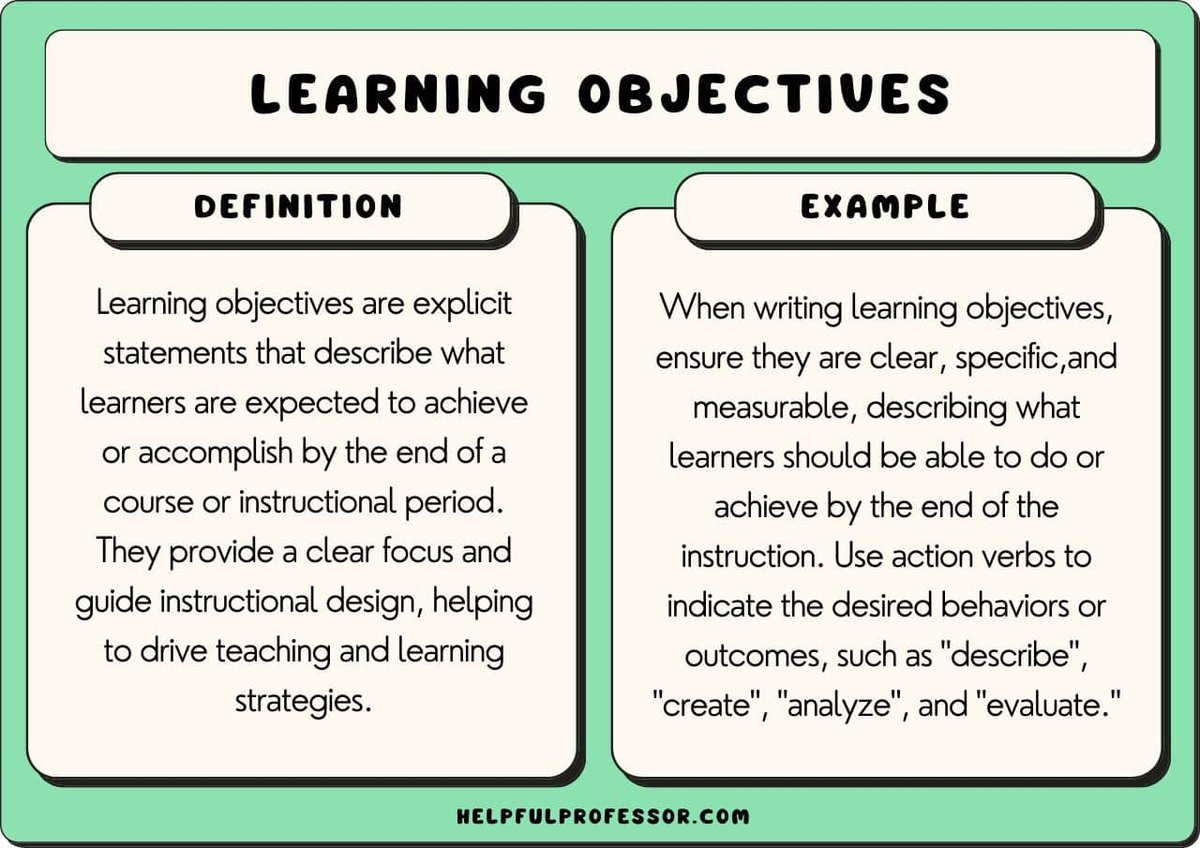
- Specific: Objectives should be clearly defined, avoiding vague language. Instead of "understand fractions," aim for "solve word problems involving addition and subtraction of fractions with like denominators."
- Measurable: How will you assess whether the objective has been achieved? Use verbs that allow for quantifiable assessment, such as "identify," "explain," "demonstrate," or "calculate."
- Achievable: Set realistic expectations based on students' current knowledge and abilities. Consider scaffolding objectives, starting with simpler tasks and gradually increasing complexity.
- Relevant: Objectives should align with the overall course goals and students' individual needs and interests. How does this objective contribute to their long-term learning?
- Time-bound: Specify a timeframe for achieving the objective. For example, "By the end of the week..." or "Within two weeks..."
Applying the SMART framework ensures that student objectives are not only well-defined but also practical and attainable.
Bloom's Taxonomy: A Guide to Cognitive Complexity
Bloom's Taxonomy offers a hierarchical framework for categorizing learning objectives based on their cognitive complexity. This is crucial when designing objectives that promote higher-order thinking skills.
The cognitive domain of Bloom's Taxonomy includes six levels:
- Remembering: Recalling basic facts and information (e.g., "List the major battles of the Civil War").
- Understanding: Explaining concepts and ideas (e.g., "Explain the causes of the French Revolution").
- Applying: Using knowledge in new situations (e.g., "Apply the Pythagorean theorem to solve for the missing side of a right triangle").
- Analyzing: Breaking down information into its component parts (e.g., "Analyze the themes in Shakespeare's 'Hamlet'").
- Evaluating: Making judgments based on criteria (e.g., "Evaluate the effectiveness of different marketing strategies").
- Creating: Producing new or original work (e.g., "Design a solution to a real-world problem using engineering principles").
By aligning objectives with different levels of Bloom's Taxonomy, educators can ensure that students are challenged to think critically and creatively.
Specific Examples of Student Objectives Across Disciplines
Here are some examples of student objectives across different subjects, demonstrating the application of the SMART framework and Bloom's Taxonomy:
English Language Arts:
- Objective: Students will be able to write a five-paragraph essay with a clear thesis statement, supporting arguments, and a concluding paragraph, demonstrating proper grammar and punctuation (Specific, Measurable, Achievable, Relevant, Time-bound).
- Bloom's Level: Creating.
- Measurement: Assessed based on a rubric evaluating thesis statement clarity, argument strength, grammar, and punctuation.
Mathematics: - Objective: Students will be able to solve linear equations in one variable, including equations with fractions and decimals, with 80% accuracy (Specific, Measurable, Achievable, Relevant, Time-bound).
- Bloom's Level: Applying.
- Measurement: Assessed through a quiz with linear equation problems.
Science: - Objective: Students will be able to design and conduct an experiment to test the effect of different fertilizers on plant growth, following the scientific method (Specific, Measurable, Achievable, Relevant, Time-bound).
- Bloom's Level: Creating.
- Measurement: Assessed based on a lab report evaluating experiment design, data collection, and analysis.
Social Studies: - Objective: Students will be able to analyze the causes and consequences of World War II, presenting their findings in a research paper (Specific, Measurable, Achievable, Relevant, Time-bound).
- Bloom's Level: Analyzing.
- Measurement: Assessed based on a rubric evaluating the depth of analysis, use of evidence, and clarity of writing.
English as a Second Language (ESL): - Beginner: Students will be able to introduce themselves and ask simple questions about age, origin, and hobbies, using basic vocabulary and grammar structures (Specific, Measurable, Achievable, Relevant, Time-bound).
- Intermediate: Students will be able to participate in a simple conversation about their daily routine, expressing opinions and asking for clarification (Specific, Measurable, Achievable, Relevant, Time-bound).
- Advanced: Students will be able to write a persuasive essay arguing for or against a specific topic, using complex vocabulary and grammar structures, and supporting their arguments with evidence (Specific, Measurable, Achievable, Relevant, Time-bound).
Practical Playbook: Implementing Student Objectives
Here's a step-by-step guide to effectively implement student objectives in your classroom:
- Identify Learning Goals: Begin by identifying the overarching learning goals for the unit or course. What key skills and knowledge should students acquire?
- Break Down Goals into Objectives: Deconstruct each learning goal into smaller, more manageable objectives. Use the SMART framework to ensure that each objective is specific, measurable, achievable, relevant, and time-bound.
- Align Activities and Assessments: Design activities and assessments that directly support the achievement of the objectives. Ensure that students have opportunities to practice and demonstrate their learning.
- Communicate Objectives Clearly: Clearly communicate the objectives to students at the beginning of each lesson or unit. Explain why the objectives are important and how they relate to the overall learning goals.
- Provide Feedback: Provide regular feedback to students on their progress towards achieving the objectives. Highlight their strengths and areas for improvement.
- Reflect and Adjust: Continuously reflect on the effectiveness of the objectives and adjust them as needed based on student performance and feedback.
Pitfalls to Avoid:
- Vague Language: Avoid using vague verbs like "understand" or "appreciate." Use more specific verbs like "explain," "demonstrate," or "analyze."
- Unrealistic Expectations: Set realistic expectations based on students' current knowledge and abilities. Avoid setting objectives that are too challenging or too easy.
- Lack of Alignment: Ensure that the objectives are aligned with the overall learning goals and that the activities and assessments directly support their achievement.
Quick Answers: Addressing Common Questions
Q: How many objectives should I have for each lesson?
A: There's no magic number, but aim for 2-4 focused objectives per lesson. More than that can overwhelm students; fewer might not provide enough direction.
Q: What if students don't meet the objectives?
A: This is an opportunity for reflection and adjustment. Provide additional support, reteach concepts, or modify the objectives based on student needs. Don't penalize students for not meeting objectives; use it as a learning experience.
Q: How do I involve students in setting objectives?
A: Involving students can increase their motivation and engagement. Brainstorm objectives together, allow students to choose from a menu of options, or have them reflect on their learning goals.
Q: What about differentiation?
A: Differentiate objectives to meet the diverse needs of your students. Provide different levels of challenge, offer alternative assessment options, or allow students to pursue different learning paths.
Your Next Steps: Making Objectives a Reality
Crafting effective student objectives is an ongoing process of planning, implementation, and refinement. By using frameworks like SMART and Bloom's Taxonomy, and by learning from examples of student objectives, you can create a learning environment where every student has the opportunity to succeed. Start small, experiment with different approaches, and continuously reflect on what works best for your students. The journey to clearer, more impactful objectives starts now.